Saturday, April 4, 2015

Blog Post #11


What can we learn about teaching and learning from these teachers?
 
Back to the Future - Brian Crosby's lecture was incredibly educational. It really expanded my ideas of how you can make learning exciting and break it out of the classroom. One point that stood out for me was how he used blogging in place of standard test taking. His students learn their material, often with projects and interactive activities, and then blog about their experience and new knowledge while answering questions based on that knowledge they have "gotten their hands in" so to speak. This connects the students with their learning tremendously more than paper and pen every would. He also discusses how his students connect globally and are immersed in the world, the entire world, not just their corner of it. Crosby is obviously a wonderful, passionate teacher that inspires his students and creates a learning environment in which each student,even those that can not be there physically, can interact and learn.

Blended Learning Cycle-Paul Anderson's vlog about blended learning tells you how to incorporate technology into a traditional classroom. He has six parts to his blended learning cycle.He has a number of learning cycles, and likes to make acronyms out of them. For example, QUIVER.  You begin with a Question-or a hook. This is what gets the students thinking in the first place. Next
Investigate-get the students to flesh out and explore the question. Then comes a Video-this allows Anderson to free up time for questions and students can watch the video independently and learn at their own pace. Then is Elaboration, students read section from the text and do problems that allow them to go in depth with their learning then Review-Anderson meets either individually or in small groups with the students to make sure they are on the right track. They can not move on to the last part the Summary quiz, until Anderson is assured they have a good understanding and are familiar with the material.

Sam Pane Fourth Grade-Sam Pane discusses how to be a good "digital citizen". He is energetic and engages his students. He has them think of themselves as digital super heroes. What a fun way to get students to be aware of the importance of their actions in the digital realm.In one exercise, the students put their super hero in a situation in which people are being irresponsible or disrespectful, and their character steps in and saves the day. Then he has the students do a gallery walk, in which they review each others work and think about these different situations and how they translate to real experiences and issues they may encounter online.
 
Making Thinking Visible-Ron Ritchhart discusses the importance of working together as a group with students to develop understanding and to create a supportive atmosphere of thinking. He discusses how the world is becoming more globally connected, and students these days need to be see the world from different perspectives. This makes me think of Brian Crosby's lecture, and how he uses his classroom to help students connect with students all over the world and learn about the issues they face.

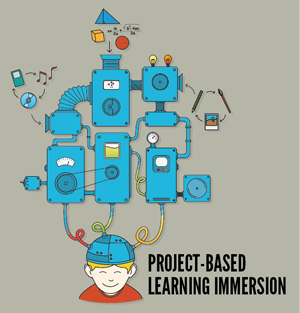
Project Based Learning- Dean Shareski's vlog  portrays three different teachers discussing the integration of PBL's in history and english courses. They restructured their days to give themselves time to go deeper into learning, to blend their ideas, and time to provide better feedback for students. This expands their students learning, and teaches them above and beyond the required curriculum. 
 
Roosevelt Elementary bases there PBL's on real world problem solving, taught within the classroom. Teachers get together and collaborate on their projects. I find that wonderful, because in some of the other videos I have watched on PBL's some teachers seem to have been on their own when it comes to creating projects for PBL's. These teachers show their students that they trust them, in that they allow their students choices, and enable them to learn skills applicable to the "real world". This prepares them much earlier than a traditional classroom to cooperate in groups and develop social skills and problem solving skills. This also enables teachers to learn student's strengths and weaknesses better, and to see which learning style works best for individual students. PBL's bridge the gaps in learning, as some projects will require work that spans subjects and skills. 


Sunday, March 29, 2015

Blog Post #10

What can we learn from Mrs. Cassidy?
Mrs. Cassidy effectively uses technology in her classroom to enhance her student's learning. For example, she uses blogging to help her students become better writers. They play games on a Nintendo DS to learn problem solving skills, and how to share. Blogging provides an audience for students, and creates an environment in which others read and respond to their work. Mrs Cassidy suggests starting your journey in technology through whatever your interests are. For example, if you like photography, start a Flickr account;  if you're a writer, start blogging. This can be transferred to student's needs and interests. 
Technology can be used in shaping a classroom to cater to individual student's capabilities and interests. I could see myself using blogging in the classroom, as well as problem solving games. The only problems I could foresee might be distractions while using the computer. Students might try to pull up sites other than the ones they are supposed to be on while the teacher isn't paying attention. Still, that is a minor problem and I don't think it would be a major adverse effect on their learning.  
There are major benefits in opening up a classroom to technology. If they are engaging in interactive activities, they are less likely to become bored with the material, and education becomes interesting and fun for them. As the videos, and the videos I have watched throughout the course of this class have shown, technology is a must for a teacher that really wants to expand their student's learning and development.  
Below are links to videos of Mrs. Cassidy explaining how to implement technology in the classroom, and also how those implementations have benefited her classroom. 

Saturday, March 21, 2015

Video Book Conversation


Blog Post #9

What Can Teachers and Students Teach Us About Project Based Learning?


Project Based Learning fosters a deeper learning experience as evident in the videos I watched and posts I read in preparation for this post. According to Tony Vincent's video Project-Based Learning for Teachers, project-based learning requires deeper thinking and is based around the student, not the teacher. There are crucial aspects to project-based learning that include having a purpose, addressing an audience, crafting a driving question, identifying learning standards, creating a rubric, grouping students, brainstorming branching questions, meeting deadlines, and focusing on the process. All of these put the learning process in the hands of the students and allows them to "think outside the box"so to speak. In addition, it makes learning more interactive and more rewarding because instead of just listening to a lecture and "burping back information", the students get to create something thoughtful and meaningful.
A great post to point a teacher in the right direction for project-based learning is Ten Sites Supporting Digital Classroom Collaboration in Project Based Learning. It is just what the title says, pretty self explanatory! Hopefully by the time I start teaching I will still be able to utilize these tools, unless our ever expanding world of technology has surpassed this technology by then. The way in which a class must be taught is changing, these tools will help educators change with it.


Saturday, March 14, 2015

Blog Post #8

What Can We Learn About Teaching and Learning From Randy Pausch?


Randy Pausch was a professor at Carnegie Mellon University, who taught computer science, human-computer interaction, and design. From the video, I learned he was a great orator. His speech was engaging, personable, and personal. He began with his childhood dreams. His personal stories, casual language, and photographs made him seem like a "normal" person, without a staunch division of lecturer/student. It made me think that in order to better relate to students, and make them more comfortable speaking their minds and asking questions they may not feel comfortable asking a teacher with which they do not feel connected. He cared about his field and he cared about his students. He "broke the mold" and encouraged his students to do so as well. He focused on "edutainment" and group-based projects. He taught me that in order to get the most out of students, you can not focus on book-learning. You must engage them as fully as possible and partake in active, not passive learning. He had his students give each other feedback to see how well they work with others and how effective they were at their part in the group. This is a great way to make students self-aware and will be useful in their adult careers. Pausch also talked extensively about "head-faking" students, teaching them something hard while they are focused on the fun part of the project. He also stressed another point I have learned during this course, students are just as much teachers to us as we are to them. These are just a few points I learned from Pausch. I am sure if I re-watch the video I could make an entirely new list of more things this video taught me. He inspires me to be the kind of teacher he was, and sparked my curiosity on how I can achieve what he achieved in the field of computer science, in the field of history.


Sunday, March 1, 2015

Project #7B


C4K summary

 The first child's blog post I was assigned to is named Alejandro P. His post was about the winter weather in his home state of Kansas. He does not like the winter for all of the snow and inability to play outdoors. I told him I enjoyed his post, and that it does not snow very often in Alabama. I also told him I agreed it wasn't as fun to play indoors, but at least he could still have fun with boardgames, coloring, or make believe to name a few indoor activities.

The second blog I posted on was an eighth grade student named Tyler H. He discussed his typical diet and included the calorie count for each food choice listed. I commended him for including that information as it is useful for people who are dieting or have a disease such as Diabetes. I also suggested he corrected the word mourning, for which he meant to use the word morning.

The third blog I posed on was from a fourth grader named Zane. He posted a brief book review of The Son of Neptune, he also included questions that arose for him during his reading. I praised him for writing a book review so interesting it made me want to check out the book for myself. I also asked him if he was interested in Greek mythology in general.

The fourth blog post I read was from a high school student named Noah. Noah's post was a short entry on Jackie Robinson. I told him it was a good post overall, but that he may want to change some of the wording to make it a better post.

The fifth post I read was from a high school student named Alex. All the post said was "my name is Alex, I like video games." It was the only post he had so I tried to make the most of it by asking what sort of video he games liked and that he may want to capitalize the first letter of the sentence.

The sixth post was from a student named David. He posted a blog about the problem of labeling all Muslims as terrorists and whether or not that was okay. He does not agree that it is acceptable to treat people this way. I told him he was right,that he was wise beyond his years, and from his post I gather he thinks for himself and is unwilling to accept hatred against an entire religion for something not endorsed by all the members of that religion.

The seventh post was by a seventh grade student named McKinzie Q. Her post was a book review on So B It. I told her the book review made me want to find out what the story was about. I mainly focused on telling her she may want to correct her spelling, and tried to lightheartedly point out that a slight misspelling can completely alter a sentence's meaning.

The eighth post was by a seventh grader named Jaxon Dracula. His post was a book review on a book from the Left Behind series. He did an excellent job, which I told him. I also told him he did a better job of sparking interest for me about that book, of which I have heard of before, but never thought I might find worth the read. He was very articulate and his post had excellent spelling and grammar.

The ninth post was by a high school student named Jaea. She wrote about being true to yourself even if it means being by yourself in your views. It was a brief, to the point post, but it achieved getting her point across. I told her it wasn't everyone who is willing to be true to themselves even if it means going against the grain.

The tenth post was by a grade schooler from New Zealand named Cruz. I commented on a brief post that included a picture of his infant niece and nephew. His post told the story of a family birthday party he attended. I told him it sounded like he had a fun time and that I hope he has many more family adventures.